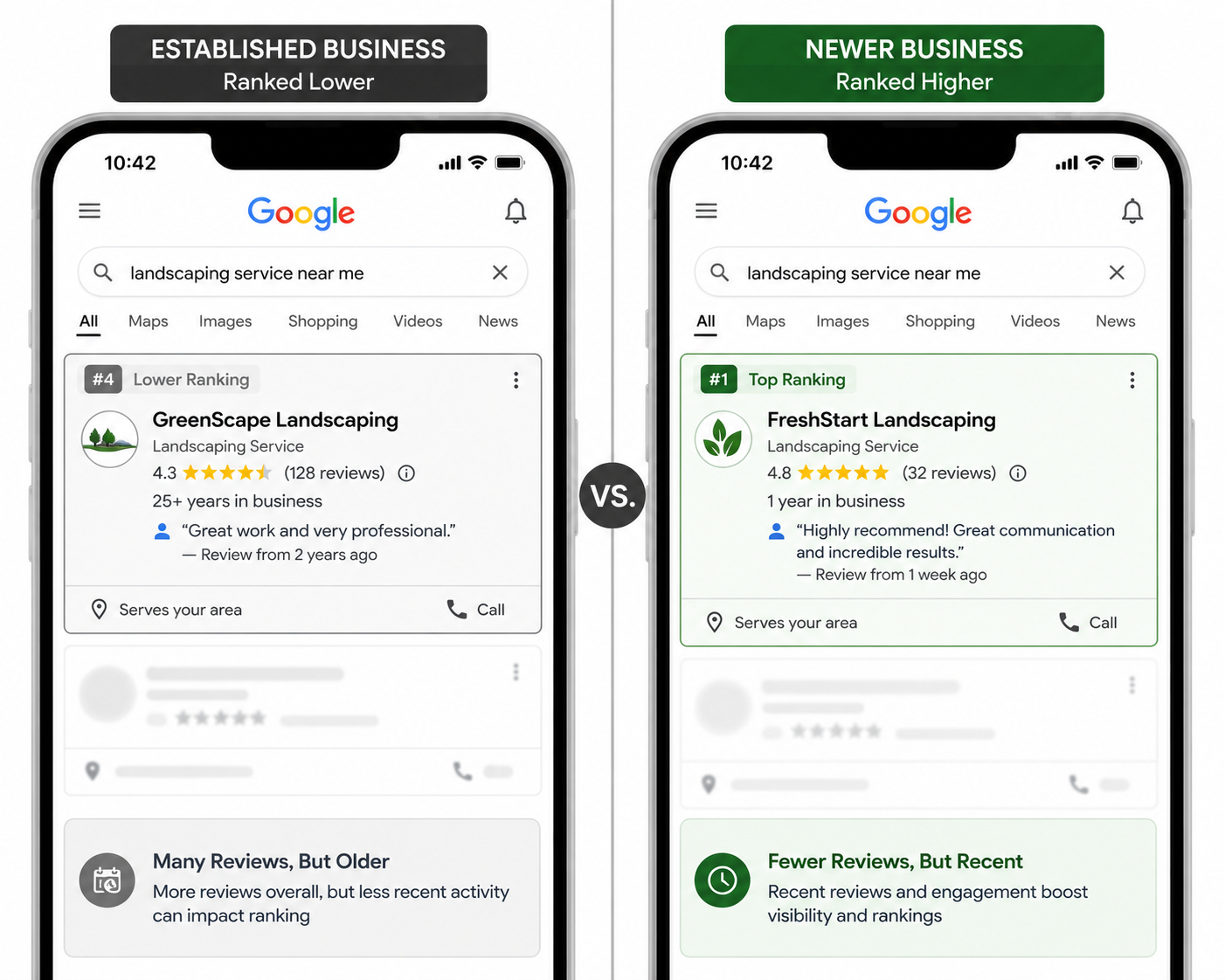
Google's local search algorithm now prioritizes review recency over review count, meaning businesses with hundreds of five-star reviews can lose rankings to competitors with fewer but fresher reviews.
Your 200 five-star reviews are hurting your ranking.
Why Your Review Strategy Stopped Working
You probably assume that building up hundreds of five-star reviews gives you a permanent ranking advantage. Most established business owners do.
A physical therapy clinic with 180 five-star reviews dropped from third to eighth in local search results because their last review was posted six months ago. Meanwhile, a newer clinic with only 45 reviews but three posted this week now ranks fourth. The established clinic had better ratings, more reviews, and years of patient trust. None of that mattered to Google's current algorithm.
Google's ranking system treats review recency as a trust signal. Fresh reviews indicate an active business with current customers. Old reviews, even perfect ones, suggest a business that might be declining or inactive.
What Stale Reviews Are Actually Costing You
Dropping 3-5 ranking positions costs between $1,200 and $2,800 in lost monthly revenue. Those are real dollars walking past your door to competitors who show up higher in search results.
This happens to competent business owners who built their reputation over years. You earned those reviews through excellent service and strong relationships. The ranking drop is not a reflection of your work quality. It is Google's algorithm responding to patterns that suggest business velocity.
78% of B2B buyers purchase from the company that responds first, not the best or the cheapest, according to the Lead Response Management Study. Google's algorithm mirrors this buyer behavior. Speed and recency signal active, trustworthy businesses that can handle new customers.
How Review Velocity Changes Rankings
The businesses that resolve this understand review generation as an operational system, not a marketing afterthought. Google measures review velocity alongside review volume. A steady stream of recent reviews signals business health more strongly than a large collection of old reviews.
What I see work consistently is treating review requests like any other business process. The most effective approach involves systematic timing and specific customer touchpoints that generate reviews within days of service completion.
This is not about gaming the system or generating fake reviews. It is about creating reliable processes that capture authentic feedback from satisfied customers while that experience is fresh in their minds. The businesses that implement review velocity systems maintain their rankings regardless of what established competitors accumulated in the past.
Review recency also compounds with other ranking factors. Fresh reviews boost click-through rates, which Google tracks as another engagement signal. Higher click-through rates improve rankings, which generate more visibility and more clicks.
The Ranking Reality No One Talks About
Your established business has an advantage, but only if you activate it. Years of five-star reviews create credibility that newer businesses cannot match. But that credibility only works when combined with recent activity.
Google's algorithm assumes that businesses generating fresh reviews are growing, active, and worth recommending to searchers.
How confident are you that your review generation process can compete with businesses that understand ranking velocity?