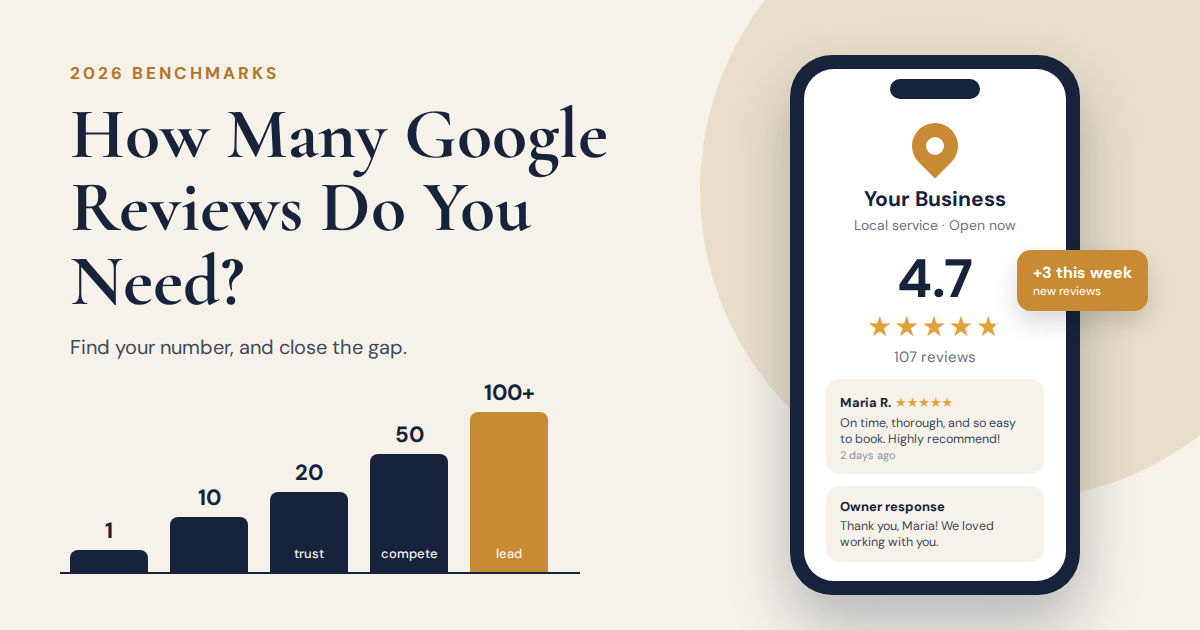
Most businesses need 20+ Google reviews to earn trust and about 50 to compete. Here's how to find your exact number in 5 minutes.
Quick answer: You need 1 Google review to show a star rating, about 10 to get a ranking lift, 20 to earn most customers' trust, and roughly 50 to compete in the local map results. The real target depends on your market. Average the review counts of the top 3 businesses in your area on Google Maps, then add 20%.
Most owners I talk with don't have a customer problem. They have happy customers who never say so online. That gap costs them calls, bookings, and revenue every week, and it's quiet enough that nobody notices.
Let's find your number.
Yes, but it's one factor among several. Google ranks local results on three things: relevance (how well your profile matches the search), distance (how close you are to the searcher), and prominence (how well known you are). Google lists review count and rating as part of prominence (Google Business Profile Help).
So there's no single magic number. A contractor with 35 reviews can lead a small town while a dentist with 150 sits on page two in a big city. Your competitors set the bar.
| Milestone | What it does | Source |
|---|---|---|
| 1 review | Shows a star rating on your profile | |
| 5 reviews | Purchase likelihood is 270% higher than with zero reviews | Spiegel Research Center |
| 10 reviews | Measurable ranking lift in Google Maps; the effect levels off right after | Sterling Sky, 2025 |
| 20 reviews | 47% of consumers won't use a business with fewer than 20 | BrightLocal, 2026 |
| ~50 reviews | Close to the average for businesses in Google's top 3 map results | BrightLocal Google Reviews Study |
| 100+ reviews | One bad review barely moves your average; the minimum in busy categories | Industry pattern |
10 reviews: people can find you. Sterling Sky moved three businesses from 9 to 10 reviews, and all three gained ranking for their main keyword. Businesses that went from 10 to 11 saw no similar gain (Sterling Sky). At 10, your profile also stops looking new or abandoned.
20 reviews: people trust you. In BrightLocal's 2026 survey, 47% of consumers said they won't use a business with fewer than 20 reviews, and only 9% would use one with five or fewer (BrightLocal Local Consumer Review Survey 2026). Below 20, you can be visible and still lose the click.
50 reviews: you can compete. BrightLocal found businesses in Google's top 3 local results averaged 47 reviews and a 4.47-star rating, compared with 39 reviews for local businesses overall (BrightLocal Google Reviews Study). That study is from 2018, and review counts have grown since, so treat 50 as a floor rather than a finish line.
100+ reviews: one bad day can't sink you. At this volume, a single one-star review barely moves your average. In busy categories like restaurants and auto services, 100 is the minimum to stay in the running.
Use the Beat-the-Average Target. It takes about five minutes.
Why add 20%? Your competitors keep collecting reviews. If you aim for today's average, you'll be behind by the time you get there.
Pull up your Google Business Profile and answer four questions. A "yes" to any of them is a gap you can close.
Nobody is really buying reviews. They're buying more booked appointments, more quote requests, and the customer who would otherwise go to the business down the street. Reviews are how you get there.
Customers check the dates. In BrightLocal's 2026 survey, 74% of consumers said they look for reviews from the last three months, 32% want reviews from the last two weeks (up from 20% in 2025), and 18% want reviews from the last week.
Google notices when reviews stop. In a 2025 case study, Sterling Sky watched a client's rankings slip after its review program paused, then recover once new reviews resumed (Sterling Sky). Their advice is to match your competitors' pace. If they get new reviews every week, you should too. In smaller or less competitive markets, one a month may be enough.
A steady flow beats a burst. Thirty reviews in one push followed by silence looks less active than a few reviews every month.
Often, yes. The Spiegel Research Center at Northwestern found that "purchase likelihood typically peaks at ratings in the 4.0 – 4.7 range, and then begins to decrease as ratings approach 5.0" (Spiegel Research Center). Perfect scores look filtered. A few honest three-star reviews with thoughtful replies make your profile more believable.
Written detail beats stars alone. Reviews that mention the specific service and the town give Google more context for matching your profile to searches, and they give customers something real to read.
Customer volume varies a lot by industry, so expectations do too. BrightLocal found hotels, restaurants, and bars carry the most reviews, while accountants, landscapers, and senior living services carry the fewest.
| Industry | Rough review target | Why |
|---|---|---|
| Restaurants, cafés, bars | 300+ | High daily volume; recency matters most |
| Hotels and hospitality | 300+ | Travelers compare options side by side |
| Auto dealers and repair | 150–300 | Expensive, stressful purchases need a big sample |
| Dentists, med spas, salons | 100–200 | Repeat visits create steady review chances |
| Home services (HVAC, plumbing, cleaning) | 75–150 | Urgent searches; 50 is the floor |
| Lawyers, financial advisors, accountants | 30–75 | Fewer clients; detail outweighs count |
| Niche B2B and professional services | 15–40 | Low volume; passing 20 often leads the category |
These ranges are rough national patterns, not requirements. A rural practice may lead its area with 40 reviews while a downtown one needs 250. The table tells you what kind of race you're in, and the Beat-the-Average Target tells you where the finish line is.
Most businesses miss their target because nobody asks at the right moment, and when someone does ask, writing the review feels like homework. The customer means to do it later, and later never comes.
What works:
What never works: buying reviews, asking only your happiest customers, or screening out unhappy customers before they reach Google. All three violate Google's review policies, fake reviews are banned under the FTC's rule on consumer reviews, and the too-perfect profile they produce is exactly what customers distrust.
One review shows a star rating, but it isn't enough to earn trust. Only 9% of consumers will use a business with five or fewer reviews, so aim for 10 first, then 20.
There's no fixed number. BrightLocal found businesses in the top 3 map results averaged about 47 reviews, but your real target is your top 3 local competitors' average plus 20%.
No. Reviews are one part of Google's prominence factor, alongside relevance and distance. Returns shrink once you pass the thresholds in your market. Recent, detailed reviews with owner replies can outperform a larger pile of old ones.
Match or beat your competitors' pace. Divide the gap between your count and your target by the number of months you want to take to close it. For most small businesses, a few new reviews every week or two keeps the profile active.
Aim for new reviews at least every two weeks. 74% of consumers look for reviews from the last three months, and 32% want them from the last two weeks (BrightLocal, 2026).
Often, yes. Purchase likelihood peaks between 4.0 and 4.7 stars and drops as ratings approach 5.0, because perfect scores look filtered (Spiegel Research Center).
Yes. 80% of consumers are likely to use a business that responds to all of its reviews, and 19% now expect a same-day reply (BrightLocal, 2026).
One review shows a rating. Ten gets you noticed, 20 earns trust, 50 lets you compete, and 100+ protects you. Your real target is your top 3 competitors' average plus 20%.
The businesses that reach these numbers don't have happier customers than you. They have a consistent way of asking.
That's what 5-Star Accelerator is for. Your customer taps or scans a small device at checkout. If they'd like help, AI asks a few questions about their visit and gives them a draft review to approve or edit. When the review posts, you get a notification and an AI-drafted reply written around the keywords people search for. You can edit it or approve it with a tap. Reviews come in steadily, and none go unanswered.
Ready to see how far behind your competitors you are? Run the five-minute Beat-the-Average Target above, then start your 5-Star Accelerator free trial or book a call and we'll close that gap together.
Start Your Free Trial → Book a Call →*Includes a one-time device fee; cancel anytime. See full trial details before you start.
About the author: Eileen Snover is a CPD-certified AI consultant based in Pennsylvania's Lehigh Valley. After 20 years in education, she now helps business owners turn happy customers into the reviews, calls, and bookings they're missing online. Read more about Eileen →