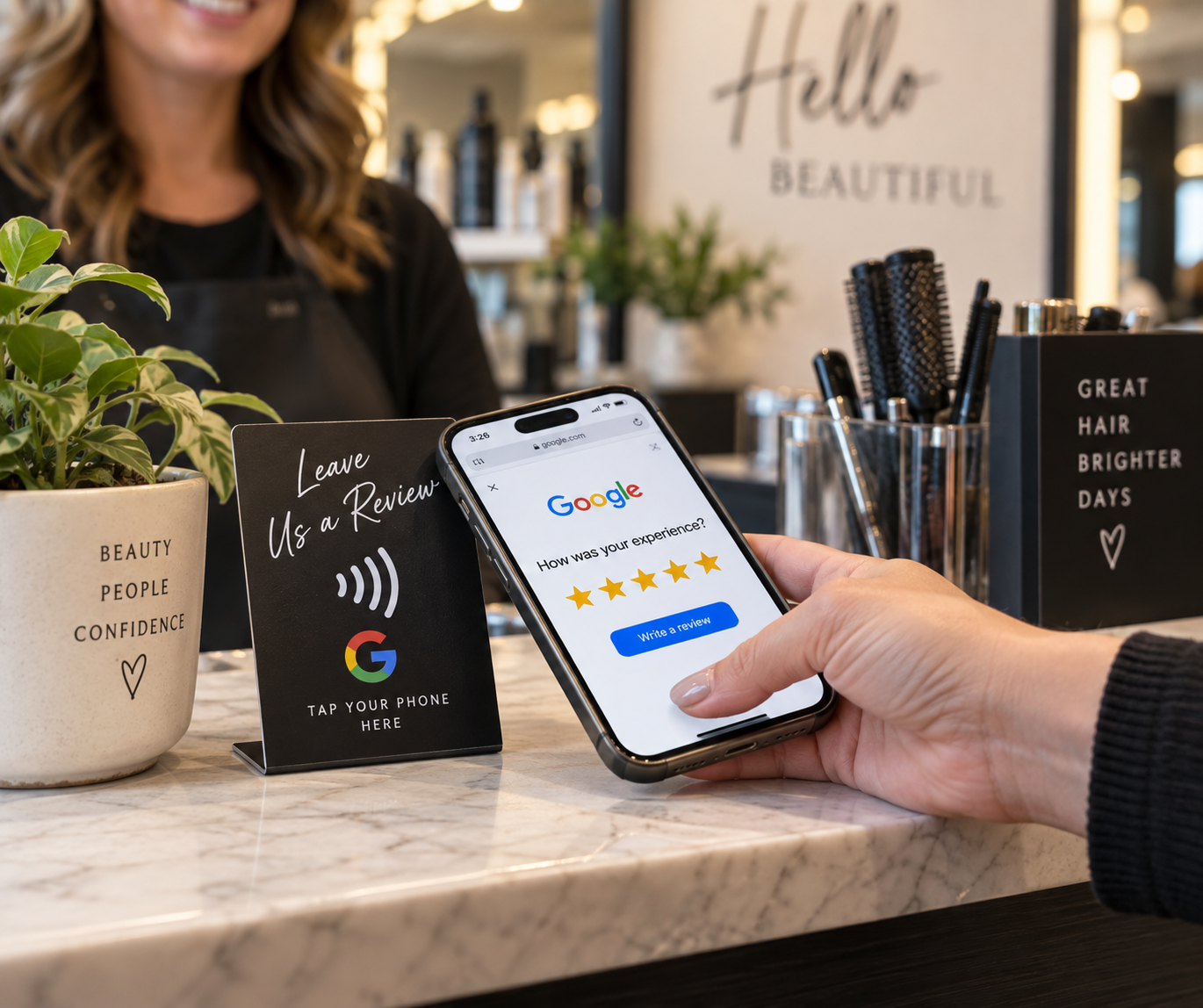
Asking customers for reviews has always been the hard part. The service was great, the customer was happy walking out the door — and then nothing. The moment passes, and the five-star review you actually earned never gets written. That's not a customer problem. That's a friction problem, and it's fixable.
An NFC review card closes that gap. One tap of a phone, and a satisfied customer lands directly on your Google review page. No app, no link to hunt down, no typing. In this piece I want to walk you through exactly how tap-to-review works, why it beats every other way of asking, and how to roll it out without running afoul of Google's rules — because that last part trips up more business owners than you'd think.
If you've been looking for the highest-ROI thing you can buy this year for your Google Business Profile, it might be this unassuming little card.
Book Your Demo →An NFC review card is a small, credit-card-sized card with a passive NFC chip built in — the same contactless technology behind Apple Pay and Google Pay — that opens your Google review page the instant a customer taps their phone to it. Most cards also carry a printed QR code as backup, so anyone with an older phone can scan instead of tap.
What makes these dependable is how little there is to them. No batteries, no firmware, no app, nothing to maintain. The chip stores one thing: a link to your Google review page. Tap, and the customer is one screen away from publishing a review. That's the whole mechanism — and that simplicity is exactly why it holds up.
For years the standard move was emailing a review link after the fact, or just hoping the customer would go find your listing themselves. Every extra step in that chain loses people — that's not a guess, that's how funnels work. A QR code cuts some of that friction. An NFC tap removes almost all of it. The strongest setup puts both NFC and QR on the same card, so you capture the customer no matter what phone they're carrying.
Tap-to-review works in four steps — tap or scan, the review page opens automatically, the customer rates and writes a quick note, and it publishes live to your profile — and the whole thing takes about five seconds. Here's the breakdown:
The timing is the real secret here. You're catching the customer while they're still standing at your counter or sitting in the chair — while the good feeling is fresh. A review request that lands in someone's inbox three days later is competing with everything else in their day. A card handed over the second the haircut's done, the meal's finished, or the repair's complete rides the wave of satisfaction instead of chasing it after it's gone cold.
Yes — roughly 97% of smartphones made after 2018 support NFC out of the box, and the small remainder can fall back on the card's printed QR code. iPhones from the XR on read NFC tags with no app required, and Android's handled it the same way since 2015. Practically speaking, this reaches every customer who walks through your door.
NFC review cards get you more reviews because they remove nearly all the friction between a happy customer and a published one — no app, no form, no link to hunt down or mistype. Every extra tap, search, or decision is a chance for someone to give up before they finish. Businesses that move from manual asks to tap-to-review commonly see review volume jump three to five times.
That matters more than it used to. According to BrightLocal's Local Consumer Review Survey, the overwhelming majority of consumers read Google reviews before choosing a local business. Google reviews aren't a nice-to-have anymore — they're often the deciding factor between you and the business down the street.
There's a compounding effect here too. Review quantity, recency, and rating all feed into how Google ranks local businesses. A steady stream of fresh reviews tells Google your business is active and trusted, which can lift you in local search and the Map Pack. Pair that with solid Google Business Profile optimization, and you've got one of the most effective local SEO moves available to a small business — no big ad spend required.
Volume isn't the whole story. Because the ask happens in the moment, the reviews you collect tend to run more detailed and more genuine — you're capturing the customer's actual experience while it's still vivid, not a flattened "great service, 5 stars" typed out three days later from memory. That authenticity is what builds trust with the next person reading your reviews.
Getting the most out of NFC review cards comes down to two things: placing them where the customer's transaction naturally ends, and asking at the exact moment they're most satisfied.
Put the card where the moment happens. Checkout counter, reception desk, salon station, the table, the invoice folder — wherever the customer journey naturally ends. Tapping should feel like the last easy step, not a chore you're adding on. Some businesses back this up with NFC stands or stickers so there's always a tap point within reach.
Ask at the right time. Timing beats almost everything else here. Hand over the card right after the service is done and the customer has seen the result — after the final walkthrough, the finished meal, the completed repair. That's peak satisfaction, and it's when someone's genuinely willing to give you ten seconds.
Explore the 5-Star Accelerator Device →Get your team involved. A card sitting unnoticed on a counter does nothing for you. What actually moves the needle is training your staff to hand it over and say something as simple as, "If you've got ten seconds, a tap here really helps us out." Once your whole team treats that as routine, the results compound fast.
Yes — NFC review cards are fully compliant with Google's review policy when used correctly, because the card treats every customer the same instead of filtering for the ones likely to leave a good review. What Google actually prohibits is review gating — filtering out unhappy customers before deciding who gets asked — and incentivizing or pressuring people into leaving one.
An NFC card is naturally on the right side of that line, because it doesn't judge the customer at all. Everyone who taps gets the same neutral path to your review page — no satisfaction filter in between, no nudge toward a particular rating. Three rules keep you compliant: offer the card to every customer, not just the ones you think will say nice things; never trade a discount or freebie for a review; and ask honestly, without telling anyone what to write or which rating to leave.
NFC cards are strong on their own, but they hit their full potential as part of a complete system. The card catches the customer standing in front of you. Automated Google review requests via text catch everyone else — the ones who paid online, the ones who left before you could hand them a card. Pair the two, and almost nobody slips through.
This is exactly where 5-Star Accelerator comes in — tap-to-review hardware paired with AI-powered review management, so you can generate, monitor, and respond to reviews from one place.
If you want a real-world look at what a simple tap device can do for a local business's reputation, there's a case study on how a $50 review device changed the game for one business owner that's worth the read.
An NFC review card is one of those rare marketing tools that's cheap, simple, and actually works. Remove the friction between a happy customer and a published review, and you end up with more reviews, better reviews, and fresher reviews — the exact mix Google rewards with higher rankings and the trust signals that turn browsers into customers.
The businesses pulling ahead this year aren't necessarily the ones doing the best work. They're the ones making it effortless for happy customers to say so out loud. Put a card on every counter. Train your team to hand it over at the right moment. Back it up with automated outreach for the customers you can't catch in person. Do that consistently, and a steady stream of five-star reviews stops being something you hope for and becomes something you can count on.
Ready to turn every satisfied customer into a glowing review? Book a 1-on-1 demo and see what 5-Star Accelerator can do for your Google Business Profile.
Book Your Demo →An NFC review card is a small, credit-card-sized card with a passive NFC chip built in — the same contactless technology behind Apple Pay and Google Pay — that opens your Google review page the instant a customer taps their phone to it. Most cards also carry a printed QR code as backup for older phones. There's no battery, no app, and nothing to maintain — the chip just stores a link to your review page.
Yes — roughly 97% of smartphones made after 2018 support NFC out of the box. iPhones from the XR on read NFC tags with no app required, and Android has supported it since 2015. The small remainder of older phones can use the card's printed QR code as a backup, so practically every customer who walks through your door can use it.
Yes, when used correctly. Google prohibits review gating (filtering out unhappy customers before deciding who gets asked) and incentivizing or pressuring people into leaving a review. An NFC card is naturally compliant because it offers the same neutral path to every customer with no satisfaction filter and no nudge toward a particular rating — as long as it's offered to everyone, never traded for a discount, and the ask itself is honest.
Businesses that move from manual review asks to tap-to-review commonly see review volume jump three to five times. The increase comes from removing nearly all the friction between a happy customer and a published review — no app to download, no link to hunt down, no typing.